Three mornings, one continuous practice
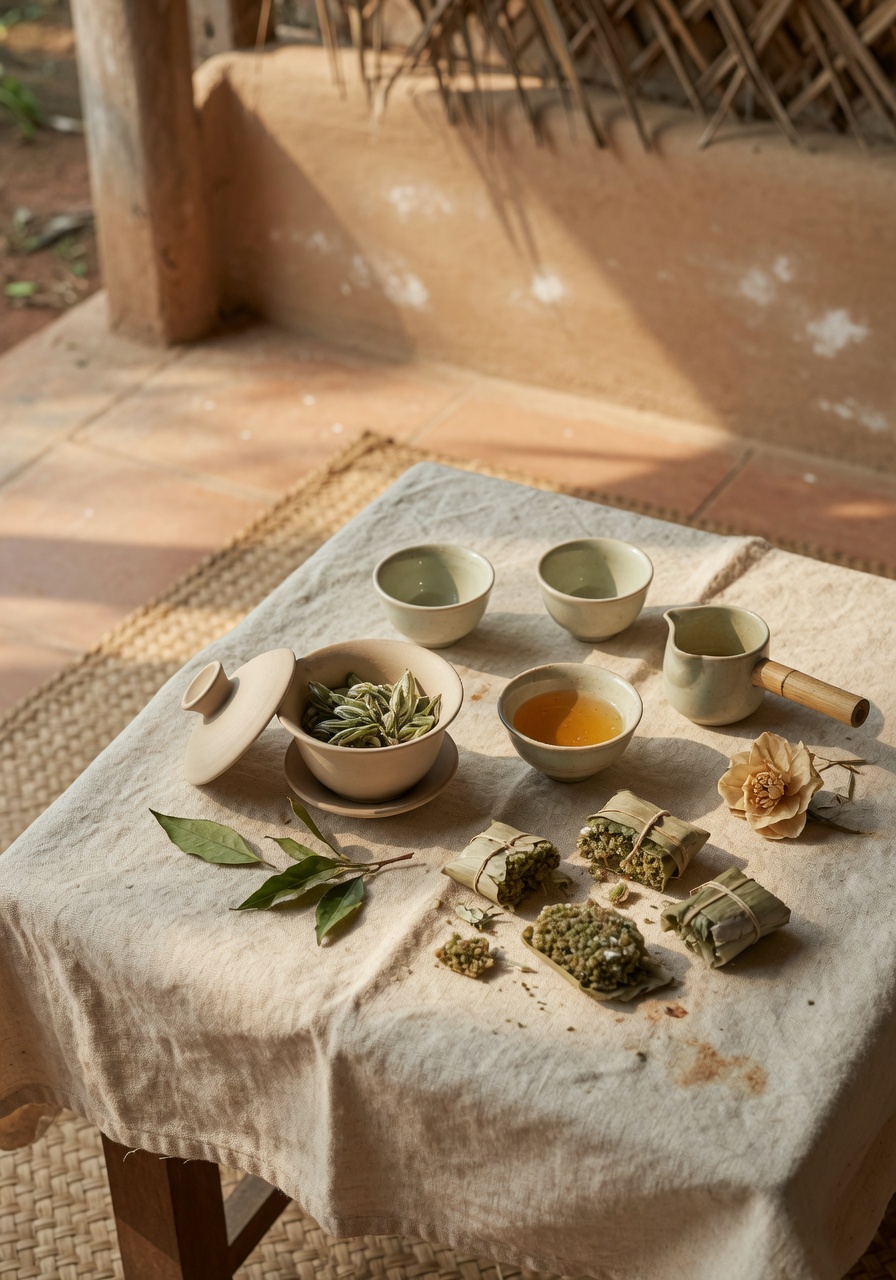
This is a small retreat — twenty mats, one shala on the inland side of Goa, and a single tasting table set under a coconut-thatch roof. The shape of each day is the same; what changes is what you notice. We begin before sunrise with Mysore-style Ashtanga, which means self-paced practice with light hands-on assistance, not a led class. You move through your series at your own breath. After śavāsana there is a slow walk back to the tasting room, water, and a sit. Then we drink young máo chá (毛茶) — the loose, sun-dried leaf from Yúnnán (云南) that has not yet been pressed into cakes or aged into Shēng Pǔ’ěr (生普洱). This is the rawest material in the pǔ’ěr world, and it asks a particular kind of attention from a body that has just finished practice.
Day one is grounding. We practice from 06:30 to roughly 08:30, then sit with three máo chá from spring 2026 — one from Bùlǎng Shān (布朗山), one from Yìwǔ (易武), one from Jǐnggǔ (景谷). Amgalan walks the table through the gàiwǎn (盖碗), pouring six short infusions of each leaf side by side. The intent is not to grade or rank but to feel what a forest tea does to a body that is still warm from backbends. We finish with a long South Indian breakfast around 10:30, then the day is yours — the beach is forty minutes, the river is closer.
Day two opens earlier with twenty minutes of prānāyāma before the mat — nāḍī śodhana and a soft ujjāyī count. Practice runs the same length. The tasting deepens: we stay with one tea, a single máo chá from a 2026 spring harvest at around 1,600 metres, and pour it ten times, watching it move from green-vegetal through honey through the faint cooling that older practitioners learn to recognize as huí gān (回甘). Amgalan talks about how this leaf will change if you press it into a 357 g cake and forget it for fifteen years. He has done this with material like it, in Buryatia and in Saint Petersburg storage.
Day three is quieter. Half-practice, full closing sequence, a long śavāsana. The final tasting is comparative — the same Bùlǎng máo chá from day one alongside a 2009 Shēng Pǔ’ěr cake from the same mountain. You taste the seventeen years between them. We close with notes, a packet of leaf to take home, and tea on the porch until people drift out.
The retreat is hosted in collaboration with tea.community and the travel logistics are coordinated through tea.travel — members of either platform can apply for a returning-practitioner rate. If you want to extend the trip into a longer study, the autumn cohort at tea.school in Yúnnán opens the week after we close in Goa, and several past participants have flown directly there.
What you get
-
Three mornings of Mysore-style Ashtanga practice with light assists, suitable for anyone with primary-series familiarity
-
Three guided tastings of spring 2026 máo chá (毛茶) from Bùlǎng Shān, Yìwǔ and Jǐnggǔ, plus one aged Shēng Pǔ’ěr (生普洱) comparison flight on the final day
-
A 100 g packet of one of the tasted máo chá leaves to take home, vacuum-sealed
-
South Indian breakfast each morning after practice, cooked on site, vegetarian and sāttvic
-
Printed tasting notebook with leaf photos, mountain map and brewing parameters
-
Small-group format — twenty mats, one tasting table, no overflow
Practical notes
-
Location — Independent shala near Aldona, inland north Goa, roughly forty minutes from Dabolim airport by taxi
-
Dress — Practice clothing you can move and sweat in, plus a light shawl for the tasting room which is shaded and cooler than the mat
-
Food — Vegetarian South Indian breakfast included after each practice; lunch and dinner are not provided, several walkable kitchens are listed in the welcome note
-
Accessibility — The shala is on one ground floor with a short flight of three stone steps at the entrance; please write ahead if you need step-free access and we will arrange a side route
-
Language — Practice and tasting are conducted in English; Russian and Mandarin can be accommodated one-to-one with Amgalan during open hours
-
Kit included — Gàiwǎn (盖碗), tasting cups, water and all teas; bring your own mat or rent one at the shala for €15 across the three days
-
Weather note — Mid-September in Goa is the tail of the monsoon — expect humidity, occasional rain and warm mornings around 26–28 °C; the shala is open-sided but covered