What the eight weeks actually feel like
This is a slow program. Eight weeks, six Chinese teas, one cohort of twenty-four practitioners, and a single rhythm repeated until it becomes structural rather than scheduled. The morning shape is the same every day — sixty minutes of asana followed by a thirty- to forty-minute gongfu cha session with the tea designated for that week. You wake, you move, you sit at the tray, you drink, you go on with your day. The repetition is the point.
Chen Hui Yi leads the cohort from Guangdong. Her work over the last decade has been with white, green and yellow teas — categories that suit a morning practice because they ask for attention without demanding stamina. The six teas chosen for these eight weeks were selected against the practice, not alongside it: each leaf is matched to a phase of the program, and the weekly group call walks through why that leaf, that water temperature, that vessel, that hour.
The asana sequencing is built for a non-studio environment. You need a mat, roughly two metres of clear floor, and a wall. The morning sequences move from a grounding standing series in weeks one and two, into deeper hip and shoulder work in weeks three through five, then into a quieter, more sattvic phase for the final three weeks where backbends soften and prānāyāma takes a larger share of the hour. Video sequences are pre-recorded and released weekly; you practice on your own clock, in your own light, with the recording running on whatever screen you keep near the mat.
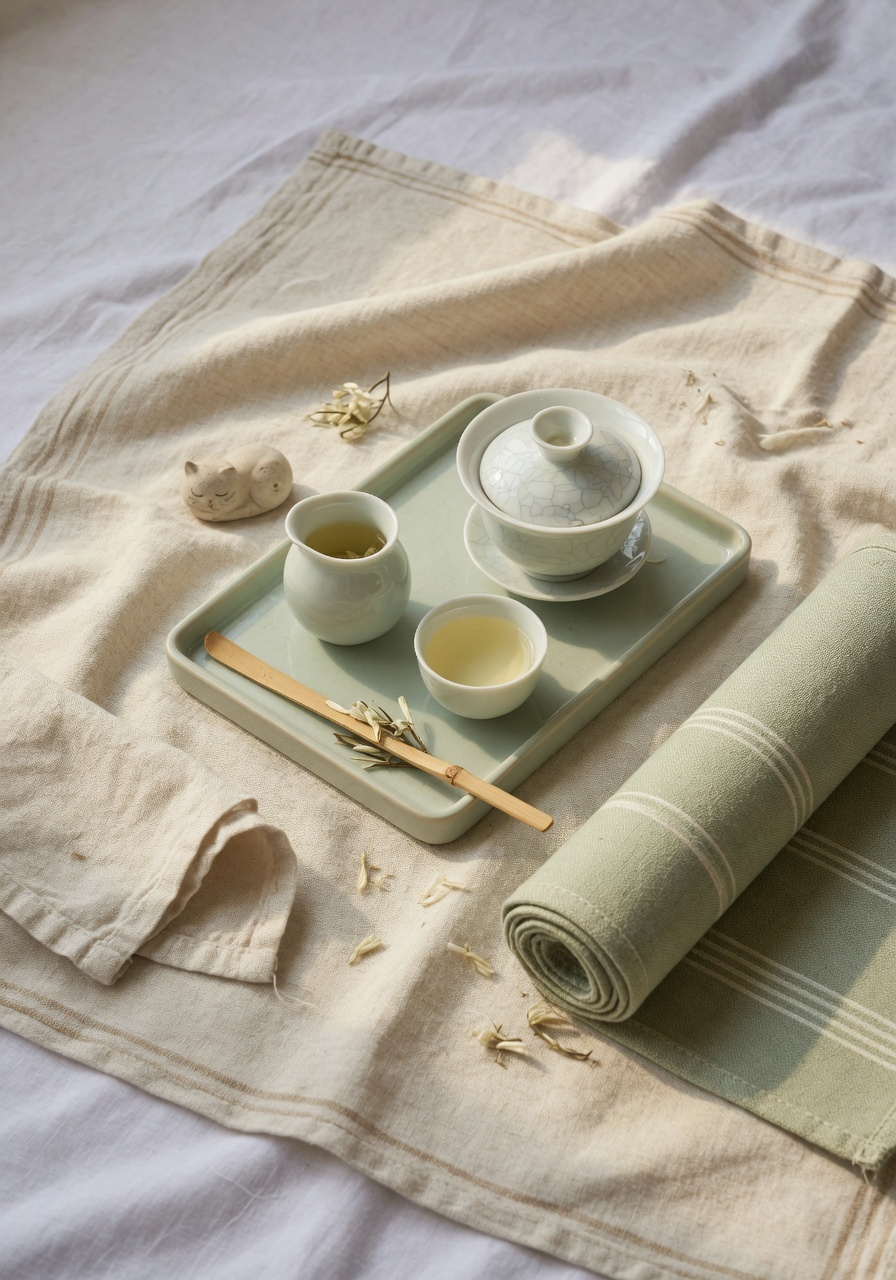
The tea half of the morning is where the cohort becomes a cohort. Leaf arrives by post before each week begins — twenty grams of the week’s tea, vacuum-sealed, with a single printed card that names the garden, the picking date, and the brewing parameters Chen Hui Yi suggests for that leaf at your hour. You will need a gaiwan or small pot (porcelain is fine, zǐshā (紫砂) clay is welcome but not required), a fairness pitcher, and three small cups. If your kit is incomplete, the equipment guide at tea.equipment lists the minimum vessels we work with, and most of what you need is already in your kitchen.
Wednesday evenings hold the weekly group call. Ninety minutes, recorded, with Chen Hui Yi brewing the week’s tea live and answering questions submitted through the cohort channel. The channel itself is private, twenty-four people plus Chen Hui Yi and one moderator from the tea.community team. People post photos of their tray, their leaf after the third infusion, their morning light. Some weeks the channel is quiet. Some weeks it is busy. Both are fine.
Pedagogically, the program is built against a specific failure mode — the one where a practitioner reads about tea for years, accumulates expensive leaf, and never builds a daily relationship with any of it. Eight weeks of the same morning gesture, with six leaves chosen in a deliberate sequence, is enough time for the gesture to become yours. By week six most practitioners report that they no longer think about the brew — water temperature, steep time, vessel choice — in the way they did in week one. The hand knows. The hand learning is what we are after.
We do not make health claims. Tea is not medicine and an eight-week cohort is not a treatment plan. If you want the clinical literature on Camellia sinensis compounds and circadian rhythm, tea.doctor keeps a small annotated bibliography. What this program offers is structure — a morning shape, a designated leaf, a teacher, and twenty-three other people doing the same thing at roughly the same hour across roughly the same eight weeks. That is enough.
Week by week
-
Week 1 — Bái Háo Yín Zhēn (白毫银针). Establishing the morning shape — standing asana, single-vessel gaiwan brewing, low temperature water
-
Week 2 — Bái Háo Yín Zhēn (白毫银针). Same leaf, deeper attention — tracking how the third and fourth infusions change across consecutive mornings
-
Week 3 — Lóng Jǐng (龙井). Hip-opening sequences and a flatter, vegetal green from Xī Hú — testing 75°C and 80°C side by side
-
Week 4 — Huáng Yá (黄芽). Yellow tea from Húnán with Zhou Xiang as guest — the mèn huáng (闷黄) sealing step explained on call
-
Week 5 — Huáng Yá (黄芽). Shoulder and chest opening; revisiting yellow tea to feel the leaf settle into the practice
-
Week 6 — Mí Lán Xiāng Dān Cōng (蜜兰香单丛). Phoenix Mountain oolong from Chen Hui Yi’s region — first oolong, longer prānāyāma segment
-
Week 7 — Shú Pǔ’ěr (熟普洱). Quieter asana, yin shapes; introducing fermented leaf and the wò duī (渥堆) story from Yunnan
-
Week 8 — Shēng Pǔ’ěr (生普洱). Closing week — young raw Pǔ’ěr, longer sitting, group reflection call replaces video sequence
What’s included
-
Eight weeks of pre-recorded morning asana sequences (60 minutes each, three difficulty layers per session)
-
Six Chinese teas shipped to your address from shop.thetea.app and shop.puerh.app — roughly 160g total across the program
-
Weekly 90-minute group call with Chen Hui Yi, recorded and archived in the cohort channel
-
Printed brewing card for each tea, with garden, picking date and Chen Hui Yi’s suggested parameters
-
Private cohort channel hosted on tea.community, capped at 24 practitioners plus moderation
-
Guest session in week four with Zhou Xiang on Húnán yellow tea processing
-
Access to the equipment starter list and discount code at tea.equipment for first-time gongfu kits
-
Lifetime access to the recorded video library after the cohort closes
-
Continuing-practice reading list curated with tea.school for practitioners who want to keep going