home · discussion
morning ritual · practice notes
Tea before or after asana — what people actually do
Members weigh in on the old question — empty-stomach *Shēng Pǔ'ěr* (生普洱) before sun salutations, or aged white tea once the body has settled. Field notes from practitioners, not prescriptions.
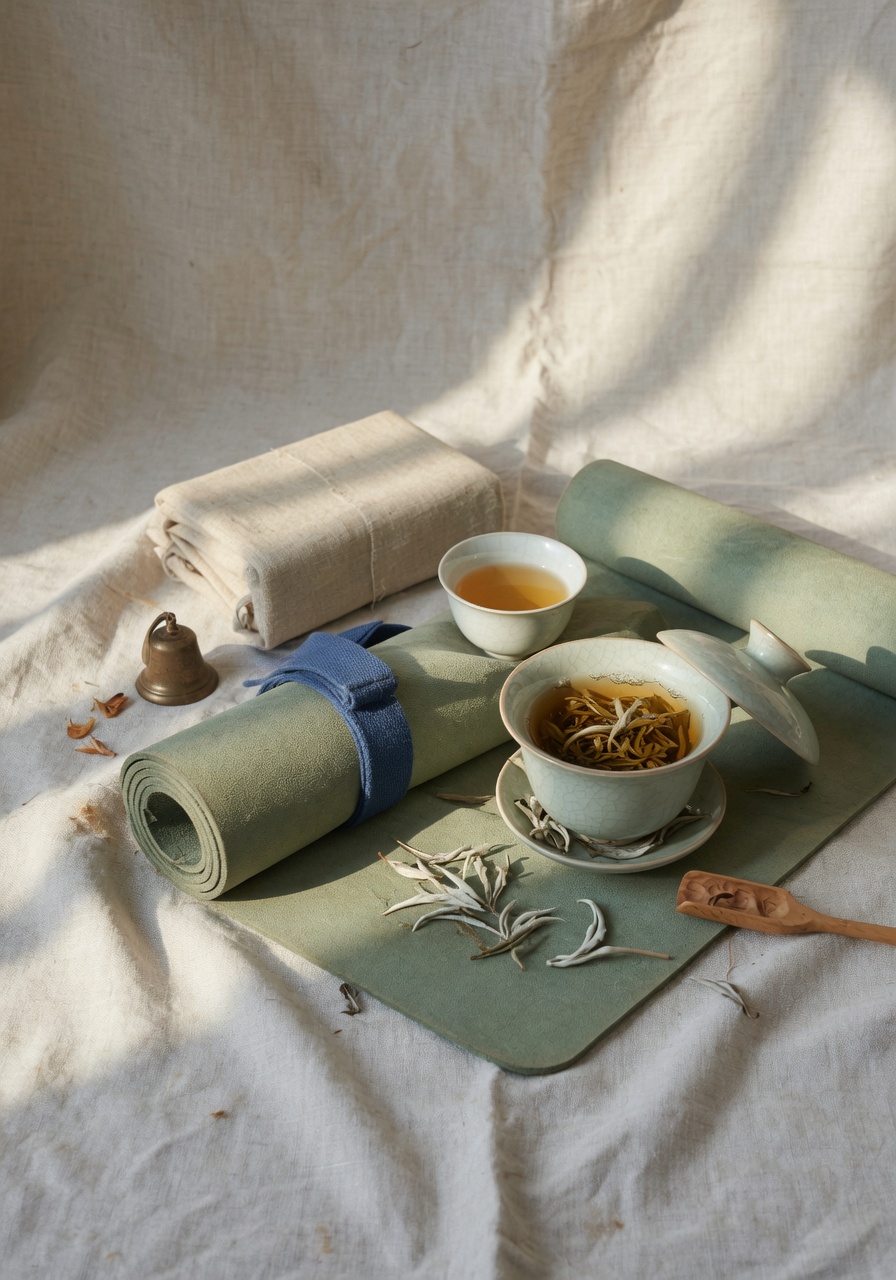
There is a recurring conversation among practitioners who also keep a tea shelf — when, exactly, does the cup belong in the day. Before the mat, after, or carefully tucked into the quiet hour that follows śavāsana. I have been asked some version of this question for nearly a decade now, mostly by students who have begun to notice that what they drink at 6am subtly rearranges how their prana moves through the first twenty minutes of practice.
The short answer is that there is no settled rule, and the long answer is that the Chinese tea tradition does not really frame itself around yoga at all — it frames itself around stomach lining, ambient temperature, the age of the leaf, and the constitution of the person holding the cup. Which means most of the useful guidance has to be reverse-engineered by practitioners themselves, often shared in the kind of low-stakes thread we are opening here.
In Guangdong, where I trained under masters who drink before sunrise without exception, the morning cup is rarely a young raw pǔ’ěr. It is more often a softened, settled tea — an aged white from Fúdǐng (福鼎), a roasted yán chá (岩茶) that has had a year to calm, occasionally a gentle shú chá (熟茶). The reasoning is practical, not mystical. A young Shēng Pǔ’ěr on an empty stomach can be sharp enough to leave the nāḍī feeling slightly wired rather than open, and that wiring tends to show up halfway through your second Sūrya Namaskāra as a quickened pulse you did not invite.
What follows is partly my own practice, partly what students have written back to me over the years, and partly the framework I would like this thread to expand. I want to hear from people who do Ashtanga at 5am, from those who teach yin at night, from anyone who has tested the same tea before and after the same sequence and noticed something. The constellation has resources for this — there is a thoughtful piece on morning shēng on puerh.app, and the hydration notes on tea.fitness are worth reading alongside this — but threads like this one are where the lived data actually surfaces.
The empty-stomach question — what Guangdong masters actually do
There is a folk belief, mostly western, that drinking Shēng Pǔ’ěr (生普洱) first thing in the morning is somehow purifying. In practice, the masters I trained with in Cháozhōu (潮州) and around Fènghuáng (凤凰) treat first-thing tea with much more care than that. Master Lin, who has run a small tea room near Fènghuáng Shān for thirty-some years, drinks a few sips of warm water first, then a softened tea — usually an aged Shòu Méi (寿眉) from 2014 or 2015. He does not touch raw pǔ’ěr until after his light breakfast.
The reason given is wèi qì — stomach warmth. Young raw pǔ’ěr, especially anything under five years from a punchy Yunnan area like Bùlǎng (布朗), carries enough astringency to leave the lining contracted. Doing forward folds and twists on that lining is uncomfortable in a way you only notice after you stop doing it. Several practitioners in our community have written that switching their pre-practice cup from a 2021 gǔshù to a 2012 aged white quietly resolved a low, dragging nausea they had not even named. There are detailed notes on how aged whites mellow over time on puerh.app under the storage section — worth a read if you are curious about which years to look for.
After asana — when the body opens, the palate opens
The reverse direction — tea after practice — is where most students end up settling, and the masters I know rarely argue with that timing. Once the body has moved through its sequence and breath has steadied, the digestive fire is noticeably more present, and a wider range of teas becomes available. This is the hour where a young Shēng Pǔ’ěr actually shines. The same 2021 gǔshù that felt too sharp at 5:45am tastes precise and bright at 7:30 after sixty minutes on the mat.
In Hunan, where my colleague Zhou Xiang works, the post-practice cup is often a Hunan hēi chá or a gentle huáng chá — something with body but without the cooling edge of green. He has written before about why he avoids cold-brewed greens immediately after vigorous vinyāsa — the temperature differential, in Ayurvedic terms, dampens agni just when it has been carefully kindled. A warm cup, brewed in a small gàiwǎn (盖碗) at around 90°C, settles the system without quenching it. Several teachers in the community have noted that they keep a second, lighter session of tea for an hour after class — they call it the talking cup, the one you share with whoever lingered after śavāsana.
Hydration, mineral content, and the question nobody asks
Tea is not water. This is obvious and yet practitioners regularly treat their morning pǔ’ěr as a hydration strategy, which it is not. A strong session of brewed tea — six or seven infusions of a 7g pour — carries enough caffeine and enough mild diuretic effect that going straight onto the mat without plain water in between is a quiet mistake. I drink roughly 300ml of warm water for every full gōngfū (功夫) session, spaced before and after.
The team at tea.fitness has reasonable notes on this for athletic contexts, and most of it transfers cleanly to āsana — the body in a 75-minute Ashtanga primary is doing real work, and electrolytes do move. Aged white teas tend to carry a softer mineral profile than young raw pǔ’ěr, which is part of why they sit so well in the pre-practice slot. A 2013 Bái Mǔdān (白牡丹) I keep at the studio is the cup I hand to students who arrive looking depleted — it warms without demanding.
Evening practice — why aged white and shú belong here
Yin and restorative practitioners tend to gravitate toward a different shelf entirely. The evening cup, particularly before a long yin sequence or yoga nidrā, wants to be grounding rather than clarifying. This is where aged white tea — a Shòu Méi with seven or eight years on it — and a well-fermented shú chá both become genuinely useful. The Wò Duī (渥堆) process that defines ripe pǔ’ěr leaves a tea that is unusually settling on the parasympathetic side, which most ripe drinkers will recognize without needing the vocabulary.
I know a teacher in Saint Petersburg who runs a Sunday evening yin class and serves a single small cup of 2008 Shòu Méi to each participant at the door. She brews it weak — 3g per 150ml, two-minute steep — so the caffeine is minimal, and lets students sit with it for the first ten minutes of class before any movement begins. The reports back are consistent — deeper drops into the postures, less mental chatter in the long holds. None of this is medical, and none of it is prescriptive, but the pattern repeats often enough that it is worth taking seriously.
What we are asking the thread
This is the part where I would like the community to take over. The frame I have offered is the one I work from, but the actual data lives in your daily practice — the tea you reached for this morning, the one you regretted, the one you have quietly settled on after three years of testing. We have practitioners across the constellation reading this thread — Ashtangis who train before dawn, Iyengar teachers who hold poses for ten minutes, yin students who only practice at night, and people who have just started and are still figuring out whether the cup belongs before or after at all.
If you want to expand the conversation into adjacent territory — sourcing, storage, water temperature — there are deeper threads on tea.school for the technical side and tea.community for the social one. But here, on tea.yoga, the question is narrower and more personal. What does your practice ask of your cup.
Open questions for the thread
Three questions to take into your replies — first, what is the tea you actually reach for before practice, and has it changed since you started. Second, has anyone here tested the same tea before and after the same sequence and noticed a clear difference. Third, for the evening practitioners — what is your wind-down cup, and how weak do you brew it.